Showing posts with label books. Show all posts

Wednesday, 3 January 2018

Five things because I need to blog


1.     I’ve read two of my Christmas books.  The first one was an intriguing, though flawed, thriller called ‘Magpie Murders’ by Anthony Horowitz.  Tim Lott recently said in the Guardian that ‘literary fiction’, by which he meant posh novels as opposed to common ones, had lost the plot, and I sympathise with his point – I’ve tried to read some posh novels in recent years that disappeared up their own introspection – but I’m not sure where the genre boundaries are any more.  I reckon Horowitz would, if forced to classify, call his work ‘literary’; but a shortage of plot is not one of its failings.

2.     The next book was about growing, processing, storing and burning wood in Norway.  It’s informative, gripping and often hilarious – a classic example of writing quality transcending subject matter, in a way the opposite of point 1, I suppose.

3.     However, I now know more than I really need to about Norwegian chainsaws.

4.     However, if you are felling a tree for fuel, it’s a good idea to do it in the spring, when the leaves have set, and don’t take them off until the autumn.  They will continue to grow (not knowing that there aren’t any roots any more) and so extract moisture from the trunk, drying the latter that much faster for burning.

5.     The third book is ‘Islander’ by Patrick Barkham.  I’ll let you know how it goes.  We’re starting in the Isle of Man.

Wednesday, 25 January 2017

Of Mastodons, Eels, Kittens and other people


Apologies to my regular readers in Ukraine, Russia, China, Romania and Indonesia, to whom this post will mean very little.  Also to my three or four readers in this country, who might be too young or old to share my nostalgia.  I hope everyone else enjoys it.

I’ve just finished reading the two Arthur Ransome books Z gave me for Christmas.  These are ‘We Didn’t Mean to Go to Sea’ and ‘Secret Water’ (both of which are set, or in the case of WDMTGTS, start and finish in East Anglia, which presumably explains why she found them, in almost certainly the same 1950s editions that I’d read the first time around, in a local bookshop.)

My parents – my mother to be precise, because my father wasn’t a great reader; actually you can leave out the ‘great’ – dutifully supplied us kids with age-appropriate reading.  I don’t remember the full range, but it boiled down to two varieties: numerous variants on Enid Blyton’s single imaginative product; and Swallows and Amazons.

Although Z and I had shared our recollected love of these books, I was slightly nervous about returning to that world after an absence of at least sixty years – that world wouldn’t have changed, but I probably had. 

I’m not writing critical reviews of these marvellous books (oh, oops, I just did), nor will I spoil them with summaries of the plots (though I could quite easily: bunch of kids are placed in unintended peril by their remarkably self- and child-indulgent parents, survive imaginary and real threats by a combination of good luck, rapidly acquired skills and quite implausible grown-upness) or textual analysis (they do talk a bit quaint like, innit?)  Instead here’s a quick breakdown of the main characters and, most importantly, two words each on what they gave me all those years ago.

The Swallows: John (practical, anxious); Susan (elder sister); Titty (mischievous fantasist), Roger (word-playing joker).

The Amazons: Nancy (intoxicated challenger); Peggy (invisible make-weight).

Almost everything else has vanished, if it ever existed; but they haven’t changed, and nor have I.

Tuesday, 15 September 2015

Mason & Dixon, and other stories


This lot needs sorting out.


There’s more:


And that’s not counting the three or four boxes of discards already waiting to be shipped to the charity book bank.  Clearly, I need to set aside an afternoon or three, if I can find them.   Critical mass will be reached some time soon, the tipping point being when I can no longer get through the front bedroom to the ironing board.  That becomes pressing (aargh!) when I need a fresh shirt – not quite at either of those points yet, but the nights are drawing in…

So, pro tem, I’ve disciplined myself to rereading.  I started with ‘Howard’s End’ a couple of weeks ago, and reflected on how Graham Greene found it necessary to divide his output between ‘novels’ and ‘entertainments’, whereas Forster could effortlessly blend the two into a single seamless whole.  So I read a couple of Greenes, one of each sort, and was left unsure as to which approach was the better… 

Getting a bit unstimulated, a week or so ago my eye was caught by Thomas Pynchon’s Masterpiece.  It tells the story of the two Surveyors, or Astronomers (they constantly bicker over this amongst many other sundry Controversies), who in the mid-eighteenth century ran what was ever-after called ‘the Mason-Dixon Line’ ‘twixt Pennsylvania and Maryland, a Line to become in History the Fount of countless Politickal and Bellicose wranglings…

I’m sorry, I seem to have slipped into the author’s bizarre cod-Georgian idiom (and even found myself, the other day, writing a blog comment in a version of Jeremiah Dixon’s bluff Geordie-an idiolect, eeh!): it’s not a straightforward read, as anyone who’s ever tried Pynchon will confirm.  But I know few books that draw you so deeply into their mad world.  If you imagine a linear yarn – well, you’ll get that, but be prepared for diversions into sea-battles between an under-manned frigate and a fearsome French man’o’war (complete with a deckhand who alone can unravel some fine points of frigate-rigging, called Pat O’Brian); the flesh- and booze-pots of Philadelphia; contemporary American and trans-Atlantick (there I go again!) politicks and Theology; and a wholly novel slant on How The West Was Won (or Lost), and similar Systematickally Irrelevant digressions into areas I don’t even want to think too much about, because my dreams are already over-packed with that kind of stuff…

There are also: a petulant, erudite Talking Dog, called the Learnèd English Dog, whose main role, in Chapter 1, is to enable the phrase ‘The L.E.D. blinks’; a partially invisible Mechanical Duck; the invention or discovery of Surf Music; the art of witch-flying, without benefit of Broomstick, to prove that the Territory is not the Map; and much much more such absurd digressions into worlds, planets and Galaxies of Phantasie, lit by a flickering, unreliable Lanthorne…


And I haven’t even reached the end yet!  150 pages (out of 773) to go.  But I know how it finishes – they reach the end of the Line, in ev’ry sense.

Tuesday, 7 July 2015

Numb and Number


The relationship between me and mathematics has been like that between a stalker and their victim – aware of each other, but hoping never to meet face to face.  (In this simile, which will not be pursued further, maths is the stalker.)  The concept of the stuff fascinates me, but I don’t understand a bit* of it.

I’ve just almost finished a marvellous book which massively reinforces the fascination, and even, possibly, an itsy smidgeon of the understanding.  (Well, it couldn’t reduce it, could it?)  It’s called ‘The Information’, by James Gleick (Fourth Estate, 2011), and is basically a history of, well, information – its nature, how it is (or isn’t) communicated (from African talking drums to quantum computing) and, most importantly, how mathematics and information are essentially the same thing.

That’s all I’m going to say about this book, except that once or twice (all right, 150ish times), after surf-navigating a particularly turbulent stretch, my neurons and synapses (they’re in there!) felt distinctly numb.

Just a couple of snippets that particularly grabbed me:

A guy called G. G. Berry, with Bertrand Russell, cheekily constructed the Berry paradox, which goes something like this.  Q: Is it possible to name the least integer not nameable in fewer than nineteen syllables?  A: Yes: you’ve just done that.  But ‘the least integer not nameable in fewer than nineteen syllables’ actually contains eighteen syllables.  So the least integer not nameable in fewer than nineteen syllables has just been named in fewer than nineteen syllables.

That was obviously a philosophers’ in-joke, but ‘interesting’ and ‘uninteresting’ numbers are more, um, interesting.  An ‘interesting’ number, in the jargon, boils down to being one that can be expressed by an algorithm.  Hence  ‘5’ is ‘the third prime number’, ‘121’ is ‘112’.   The really interesting ones come when the algorithm is shorter than the number, thus facilitating data compression with all its essential benefits for information exchange.  But the really really interesting numbers are the ‘uninteresting’ ones, because they are random.  There’s no algorithm from which you can derive the number.  ‘Random’ numbers are a building block of modern internet security.  But the really really really interesting question is: how do you know they’re random?  Couldn’t it be that you just haven’t found the algorithm yet?  Vast resources at NSA and GCHQ are being devoted to cracking that one.

And finally, a quote: “What might not be gathered some day in the twenty-first century from a record of the correspondence of an entire people?  Andrew Wynter, ‘The Electric Telegraph’, 1845.

Sorry, that’s three snippets.  Three is more than a couple.  Like I said, numbers and me, duh.


*Carefully chosen word.

Wednesday, 15 April 2015

Old Books


What do you do with old books?  I don’t mean the fly-by-night paperbacks I haul in periodically from Waterstone’s, read once and then recycle via the bookbank up at the tip.  (Or not, sometimes they get kept, reread and, rarely, find their way into the permanent library.)  No, I’m talking about really old books.

About sixty of them have been furnishing my dining room for twenty years or more, in a bookcase next to the fireplace.  They range from assorted Prayer books and semi-religious tracts (Foxe’s Book of Martyrs, anyone?), through an almost-complete set of Dickens reissues (Unwin editions, 1930s I’d guess), to worthy tomes like The Origin of Species, Macaulay’s Essays on English History, and The French Revolution by Thomas Carlyle.  Plus a fair smattering of Victorian verse anthologies, several Works of Shakespeare, and a possibly earlyish edition of Culpeper’s Complete Herbal.  They’re all fairly tatty, almost certainly financially worthless and, most importantly, with one or two exceptions have never been read by anyone still alive.

I’m getting rid of them because I don’t think books ought to furnish a room.  I’m going to go slightly metaphysical on you now.  Books have no intrinsic value.  Their only worth is in the thoughts they express.  In turn, this value is circumscribed by the quality of both the thoughts themselves and their expression in a particular book.  But above all, if I’m right here, that worth dissolves into nothingness unless the book gets read.  I’m not going to read any of these sixty or so books, and I can’t find a way of enabling or persuading anyone else to do so.  So in every sense, they’re worthless.  So they’re landfill.  Right?

And yet.  And yet, perhaps they do contain, at least some of them, an ineluctable value beyond the paper, the cardboard and the words within them, read or not.  I skim through the flyleafs (flyleaves?) and find inscriptions which seem to carry their own stories, ones that will never be told but just might still exist in a memory or an imagination.  Certainly in an imagination, in fact: I find myself creating their lives and relationships even as I transcribe them.

Poetical Works by Moore: “Caroline Matthias on her 13th birthday from her affectionate cousin J M Laws.  Jan 1861
The May-Flower by Harriet Beecher Stowe:  “R. A. Scammell.  A birthday gift from A.G.  Feb 10th 1882
The Poetical Works of William Collins  “Edward Geo. Browne  Presented to him on the 26th May 1834 by his friend and tutor J. Blern(?) Anstis(?) with the sincerest wishes for his welfare.  St Helier Jersey

And in one of the Shakespeares: “E L Rea ‘02”  That’s my grandfather.


Tuesday, 10 September 2013

Five Things I Knew a Bit About but Didn’t Understand*


These are drawn, very loosely, from a rather marvellous book by Simon Flynn called ‘The Science Magpie’ (Icon Books Ltd, 2013).  The title tells you all you need to know about it.

1.      You believe your weight to be 8st 9oz, or in my case, 12st 3oz, right?  Wrong.  That’s your mass.  Your weight (which is measured in Newtons) will depend on where you are.  It’s a relationship between your mass and the strength of gravity, which varies from place to place.  To test this, go to the Moon.

2.      Water boils at 1000C, doesn’t it?  Well, it might do where you are, near sea level; but at the top of Mount Everest it’s just 680C.  No wonder it took them so long to get up there – couldn’t get a decent cup of tea.

3.      Heaven may be hotter than Hell, or not, depending on how you interpret the Bible and apply the relevant measurements.

4.      Guess what the most important equation was in the history of humankind?  That’s right: ‘1 + 1 = 2’.

5.      I still don’t know what ‘electrical charge’ is.

* I’m not saying I now do, completely, but it’s been fun confirming my ignorance.

Thursday, 27 June 2013

Handwriting


I had to look out some of my termly Reports from primary school, to confirm something I’ve always accepted as true: my handwriting is terrible.  The subject was labelled ‘Writing’, as distinct from ‘English Composition’, at which I seem to have done quite well (although ‘marred by untidiness’).  Here are some of the comments:

·         Poor – rather unsteady
·         Untidy – must try to slope all his letters the same way.
·         Uneven
·         Too much ink
·         Too large and irregular
·         Very poor and untidy
·         Probably tries too hard!

And a rare one:

·         Improving

My signature on official documents – cheques, the backs of new credit cards, contracts and suchlike – is similarly, let’s say, unsteady and uneven.  I blame this on a brief period during my banking career when I had to sign hundreds of ‘mail payment orders’ a day, at speed.  There’s a theory that people’s signatures evolve towards either a straight line or a circle; well, mine ended up as the contents of my green bin when the holly has just been pruned.  Complaints were received from banks around the world.

These actions and thoughts have been triggered by the arrival of my Book book, about which I wrote a few posts ago.  As a reminder, the idea is to record stuff about books – any stuff, there isn’t a plan – in this nice black-hard-covered A4 lined notebook, as a kind of archive.  My Book of Books.  Past, present, future; expectations, disappointments, love affairs.  I still like the idea, very much, but there’s one thing I hadn’t taken into account.  The blank first page is staring unblinkingly at me right now.  “If I’m to be what you think I am,” it’s saying, “you’re going to have to write considered words in me.  Preferably with a proper fountain pen, in properly sloped copperplate.”

I’m considering my considered reply.  At the moment it’s along the lines of “flip off, page one, I’ll scribble whatever I choose, with whatever writing utensil comes to hand.”  In fact, I’m just going to make some notes about ‘Lionel Asbo’, in a commensurate fashion.

At the same time, I can’t help thinking that the Book has a point.


Friday, 14 June 2013

The Book book


Or ‘The book Book’.  Either way, a brilliantly simple idea, thanks B. 

Instead of – or rather as well as – keeping a notepad beside you, on which anything from possibly-to-be-used-in-future-blog-post-quotes-from-newspapers, via debugging instructions or memorable song lyrics or transient phone numbers to data concerning books can be jotted, instead you can maintain a separate notebook (it should preferably be hard covered, A4) in which you write anything you like or dislike about books you’ve read, recently or in the past, or want to read in the future, or feel you should read, the main rule being that there are no rules, at least I think that’s how it’s meant to work (there may be a few others about inordinate punctuation and sentence length, also about the importance of strictly confining the scope to books, resisting the temptation to extend it to music, films, and other media –  otherwise running the risk of going full circle and ending up with a notepad beside you, on which anything from possibly-to-be-used-in-future-blog-post-quotes-from-newspapers, via debugging instructions or memorable song lyrics or transient phone numbers can be jotted, or even data concerning books), but I'm not sure about that, a bit more analysis might be needed, so don't wait up. 

Like I said, brilliantly simple.

Wednesday, 5 June 2013

Caravan Diaries, last weekend


On the way back from Porthgain to Wiseman’s Bridge (or Wisemansbridge as some have it), we stopped off at Narberth to pick up some essential supplies, mostly Schweppes tonic and yogurt.  Also fruit: some delicious cherries, and two ‘flat peaches’, from a wonderful shop called WiseBuys.  Have you come across flat peaches?  No, nor had I.  They’re very small, as peaches go, and, erm, flat.  And also delicious.  If your local fruitier doesn’t stock them, instruct him/her to do so.  They could be the next cranberry.
I wanted to show Narberth/Arberth off to B, so we wandered around a bit.  At the top of the high street, I noticed the bookshop.  It looked closed from a distance, but we approached anyway.  It’s open.  For reasons lost in time, the sign above the door reads ‘BOOKS Animal Kitchen BOOKS’.  If that doesn’t entice you in, what will?
The proprietor is there, just as he was a decade ago when I last visited: and I mean ‘just’; sitting behind the counter, reading a book.  “Look around,” he suggests.  “They’re arranged in categories.”  I am in no doubt that this is true, but it would take me some hours to analyse the non-Dewey system being applied, so we just wandered around in awe.  The shop measures maybe 200 square metres.  The aisles are elbow wide, if you’re slim.  And the books tower to head height, those that aren’t in floor level cardboard boxes.  There must be thousands of them. 
It’s impossible to choose one, so we drift back to the entrance.  On the way, B spots a book about Afghanistan that interests her, so picks it up.  As we’re about to pay, I see a copy of the ‘Tao Te Ching’, in poll position on the counter.  I read this when I was in my twenties, and had been thinking only the other day that I should read it again.   I reckon he assessed me as I walked in, thought “he’ll buy this, maybe,” fished it out and put it there. 

Back at the caravan, we finished cleaning the algae off the walls and the weeds from the patio, and planted up a couple of pots.  The television has packed up again, so we missed the weather forecast.  “The TV is hidden and nameless,” as Lao Tzu almost pointed out.

Friday, 31 May 2013

The Great Jimmy Gatz?


In preparation for not watching the latest cinematic attempt to turn perfection into something less, I reread the novel.  If you haven’t read it, either look away now or carry on reading – like Nick by the end, I don’t really care either way.
So, applying the rule of five:

1.      What’s great about him?  He and Daisy are in a child-child relationship, mediated by a controlling parent/child (Tom) and several powerless adults (Nick, Jordan, even Myrtle).  He’s an infantile manipulative wimp, who collapses under the least pressure.  He cheats even when he doesn’t need to.  He doesn’t even bother to make an appearance until page 54 (out of 188).  So what’s to love?
2.      Answer: precisely those flaws.  Scott proves – and remember, this was 1923 – the fragility of America.  Bubbles are designed to burst.   The genius is to condense that fragility into a single person, conceal him behind his own defences, and then prick him in such a way that you end up not even sure if there’d been a bubble in the first place.
3.      The strand of the novel.  It opens with ‘In my younger and more vulnerable years, my father gave me some advice …’ and ends with ‘borne back ceaselessly into the past.’  Although the peroration is impersonal, I like to think that Nick himself is being borne back; indeed, that the story is his as much as Jay’s or Daisy’s.
4.      Indeed, the more I reflect the more I think this is a fictional autobiographical narrative.  But then I have to admire Nick Carraway’s skilful ducking and weaving in and out.  Now you see him, now you don’t.  We don’t know what happens to him afterwards (did he marry that Midwest girl, who never gets a name?)  The others all end up either dead or gone; Nick himself fades away, in the last chapters, like a green light in the fog.
5.      The words.  Oh, the beauty of the sentences!  We all know the famous quotes, so just a couple of examples of perfection:
(page 101): ‘The rain was still falling, but the darkness had parted in the west, and there was a pink and golden billow of foamy clouds above the sea.  “Look at that”, she whispered. And then after a moment: “I’d like to just get one of those pink clouds and put you in it and push you around.”’

And (page 159): ‘He stretched out his hand desperately as if to snatch only a wisp of air, to save a fragment of the spot that she had made lovely for him.  But it was all going by too fast now for his blurred eyes and he knew that he had lost that part of it, the freshest and the best, forever.’

Oh, and all right, maybe the most poignantly banal phrase in literature, where Nick makes his peace with Tom, despite himself: ‘I shook hands with him; it seemed silly not to, for I felt suddenly as though I were talking to a child.’

Wednesday, 29 August 2012

Not Thinking

Sorry, the examples of crooked thinking will have to wait, probably for ever, because I had to watch a not very interesting documentary about Bristol Brabazons and de Haviland Comets (1 and 4; 2 and 3 never got mentioned; 1 kept crashing and 4 was mega) and VC10s vs. Lockheed Constellations and Boeing 707s   like I said, not very interesting … and when I occasionally flipped over to C4 it seemed to be either parades or ads for watches; so all in all logical analysis of rhetorical subterfuge seems to have dropped off the edge of whatever plateau I’d intended to inhabit this evening.

So just a couple of frinstances:

Next time someone says something like “everyone agrees that London must preserve its status as a hub airport”, ask them what they mean by “everyone”, and “must”; and for that matter, if they know what a hub airport is.  [Dishonest arguments 17, 21, 34.]  (It’s a transit lounge, which earns our economy precisely nothing.)

When Gideon next says that we mustn’t tax ‘wealth creators’ lest they flee the country, try to find a way of asking him who these people are (the ones who haven’t already fled, that is), and why they haven’t actually created any wealth yet, except for themselves of course.  [Dishonest argument #39, which isn’t in the book, but can be summarised as ‘lying’.]

Oh, and Lawson’s Dry Hills Pinot Noir is much better than it sounds.


Tuesday, 10 April 2012

Sorry, I’ll read that again

A piece in the Observer a few weeks ago had prompted me to muse about rereading, what we come back to and why.  I lost interest, but a friend has just reminded me of one.*  I said I’d come up with my top ten.  (I’m good at self-imposed challenges.)

To deal with the ‘why’ first, some rules are needed.  (I’m good at self-imposed rules.)  Rereading from desperation because there’s nothing new to hand doesn’t count, except when it does.**  Comfort or nostalgia are insufficient motives – for example, I will never read ‘The Lord of the Rings’ again, because though it may have been a comfort blanket in the past I now recognise that, basically, it’s crap.  And some books are just plain worn out.  I’ll never read ‘Catch-22’ again.  And big fat multi-volume sagas are not allowed, just because I say so.  So no ‘Dance to the Music of Time’, or Patrick O’Brian, or Harry Potter (hah, gotcha!).

No, the ‘why’ has to be caught in that one ineluctable word: quality.

So here we go.

·         ‘The Outsider’, by Albert Camus.
·         ‘The Great Gatsby’, by F Scott Fitzgerald.
·         ‘The Tin Roof Blowdown’, by James Lee Burke.
·         ‘The Third Policeman’, by Flann O’Brien.
·         ‘Vilette’, by Charlotte BrontĂ«.
·         ‘The High Window’, by Raymond Chandler.
·         ‘Good as Gold’, by Joseph Heller.      
·         ‘The Code of the Woosters’, by P. G. Wodehouse.
·         ‘?’, by ?
·         ‘?’, by ?
 
Perceptive as you are, you’ll have noticed two things (apart from how boring and narrowly read I am – some of those Observateurs were doing Aristotle and Thomas Mann and stuff like that): they’re not ordered; and there are two empty slots.  Those are for you to fill, with a book that you reread but I’ve probably read once at most.  You’ll have to apply some guesswork there, of course.  And obviously I can’t rank them until I have all ten.

 * It’s on the list, but I’m not telling. 

** That’s a snitch from another one on the list, by the way.

Tuesday, 24 January 2012

Linear verbiage

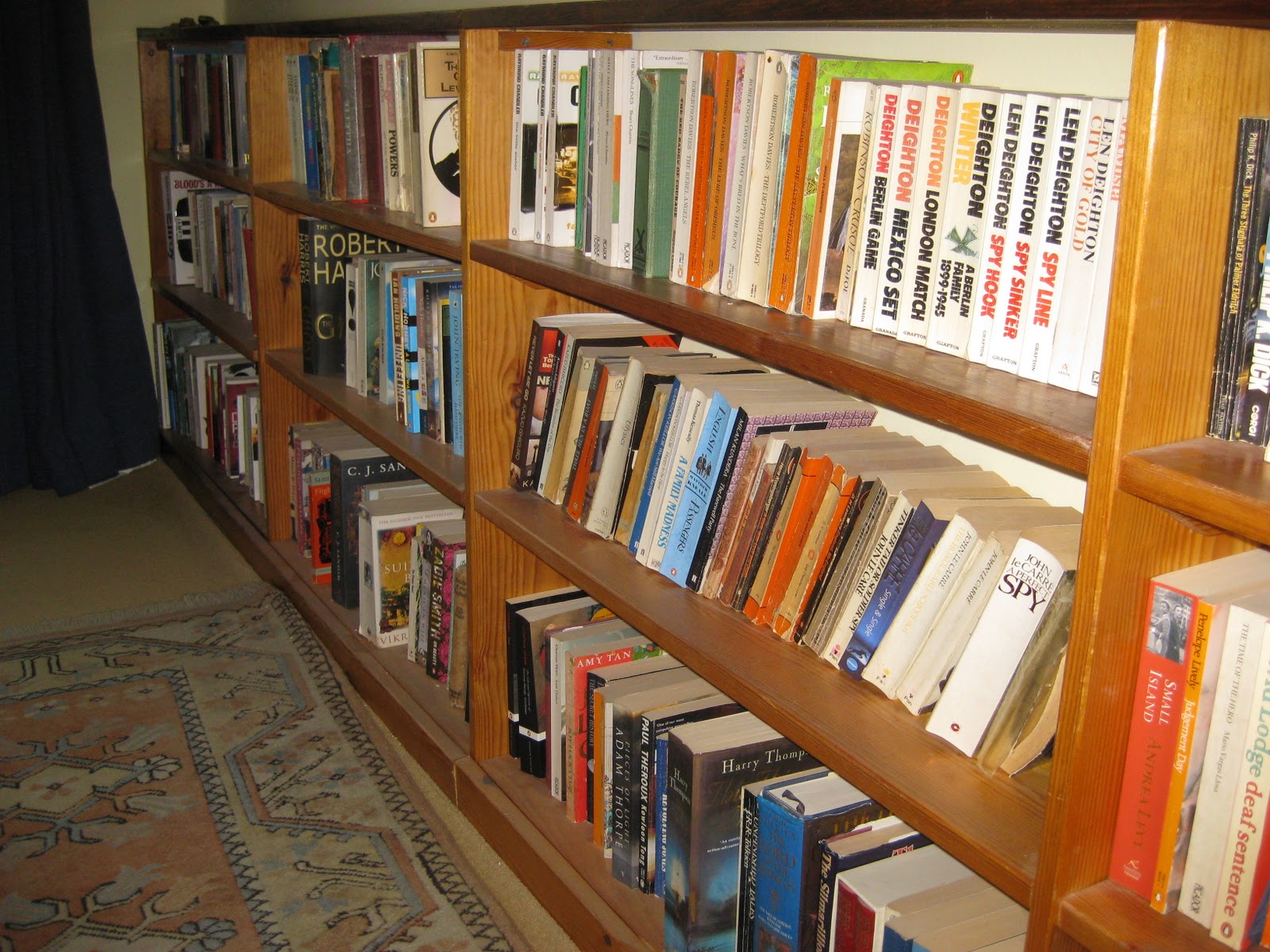
Roaring with pain sorry, pouring with rain; abject crossword dĂ©bĂ¢cle; ironing (almost) done; batch of fridge soup made; not sleepy, ain’t no place I’m going to …  So I decided to measure my books.


The methodology was quite simple.  Most of them are arranged like this on shelves, so ‘Σ shelf length times number of shelves’ gives total yardage of books, by spine. 
Approximations had to be made for this kind of situation:


And after some deliberation I decided to include the antiquarian department, out of respect:


The final outcome is that I possess approximately 28 yards of books.  I have no idea what this means.  I probably need to calculate the corresponding weight and word count for the data to become in any way meaningful.  Plus, I suppose, some form of quality weighting: maybe I can estimate how many times each book has been read, or the probability of it being read again.  But that will have to wait for another wet day, or month.

I left out certain reference volumes, including cookery books.  I have also omitted the new Kindle, for two obvious reasons.  One being the difficulty of assigning a spine thickness to an e-book; the other that there aren’t actually any books in there yet.  This is because I don’t really know what to do with the thing.  I doubt if I’ll let it supplant ‘real’ books entirely, or even in large part, so I have to find a selective rĂ´le for it.  I don’t often go on extended holidays any more, at least not the kind that contain wide open reading spaces.  (I get too much of that at home.)  I daresay it will come in useful once my arms become too weak to hold up a weighty tome, or my eyes demand magnification of 8-point text; but neither of these has happened yet (as at 3.50 p.m. today), and I’ll probably have lost the ability to work technology by the time they do.

Thursday, 18 August 2011

Reading List

In the absence of anything better to do with my leisure time (apart of course from consulting all your lovely blogs and firing the occasional inane comment at them), I read a lot.  Every fortnight or so, I tramp down to Waterstones and buy whatever of the latest '3 for 2' offers catch my eye.  [Should that be 'B3G1F?]  Failing that, I trawl my shelves for rereadables.  All that may change soon.  In the meantime, here are my twitteresque reviews of the latest half-dozen:

Gods Without Men, Hari Kunzru: Sub-early-Pynchon without the jokes.  Can the peyote, Coyote.
The Terrible Privacy of Maxwell Sim, Jonathan Coe: I did laugh a lot.  Good vignettes, and an outrageously outrageous ending.
Killshot, Elmore Leonard: Anyone wanna write a thriller with real people on both sides?  Bring it on.   (Actually, 'both' is misleading.  There as many sides as there are characters.)
The Free World, David Bezmozgis: Beautifully written sub-Tolstoyian epic of Russian emigres to Italy in the late seventies.  Easily the best new thing I've read in months.  [Spoiler alert: some of the endings are happy (I think).]
At Home, Bill Bryson: A miracle!  Bryson has managed to write a bloated, humourless, really boring book.
Life, Keith Richards: You had to be there.  And understand open five-string tunings.  I was, and I do.

And your off-the-shelf bonus ball: The Regeneration trilogy by Pat Barker.

Sunday, 8 March 2009

Book reviews

In this funny sub-season - no longer winter, not quite yet spring - I always go into a kind of sub-hibernation, a sort of restless lethargy. This year, to deal with this, between bursts of activity like pruning roses and clearing out the studio, I've been reading books by the cubic yard. So here are some one-liners about a few recent ones:

The Book Thief, Marcus Zusak: well written if slightly contrived tale of survival in Nazi Germany, with lots of sardonic humour from the narrator, Death.
The Polish Officer, Alan Furst: I discovered Furst via an earlier novel, The Foreign Correspondent. He does tense WW2 thrillers, with strong characters and devious plotlines, sort of Le Carre territory. Must read more.
Friday Nights, Joanna Trollope: not her best. I'm usually a fan, she can do good characters and sparkly dialogue, but in this case too many people (I kept having to look back - who are you again?) and none of them very interesting.
Flow My Tears The Policeman Said, Philip K Dick: he always challenges you at the borders between hallucination and reality; in this case, a proper plot would have helped.
When Will There Be Good News, Kate Atkinson: several convoluted parallel mysteries, a burnt-out ex-cop with emotional baggage, three or four very different highly charged female characters, some outrageous plot coincidences - what's not to love?
The Road Home, Rose Tremain: nothing to say except READ IT!
His Illegal Self, Peter Carey: well, this is a weird one. From page one, I had no clear idea what was going on; and devoured it at a single sitting. Somewhere between Cormac McCarthy and Steinbeck, with flashes of Russell Hoban?
Q & A, Vikas Swarup: to be quite honest and with the best will in the world - just see the film.

Friday, 28 November 2008

Villette

Last week, desperate for something to read on a grey cold damp afternoon, and unwilling to haul myself into Waterstones to load up another forest of pulp, I trawled my bookshelves for something I felt like rereading or hadn't yet read, and, more or less at random, plucked out this Victorian novel. Ten pages in, I was hooked. A hundred, I found myself telling the people off for their unreasonable behaviour or applauding them for their startling unpredictabiliy.

You have to get past the Victorian novelist's language, of course. In this case, not hard. The dialogue is the way in. These people talk like kids today (in their own vernacular). I wanted to give an example, but, skimming, realised that I couldn't, because I know them and you don't. Just think sassy wit.

The discursive passages are harder, but often even more rewarding. Again, I was tempted to quote, but again, I can't, because they lose much of their strength outside the context - and that's their strength! No Dickensian preaching here - the insights grow out of the characters, and where they sit, at that moment, within the story. You never, never think 'hang on, author, you put that in'.

Most of all, the heroine (and narrator), Lucy Snowe. As she tells her story, you're whizzed between her feisty insecurity, her coolness under fire, her intrepid risk-taking, her girly wimpishness - without once feeling that there are any contradictions or inconsistencies. I'm in love with Lucy Snowe.

Actually, apparently this novel is largely autobiographical, arising from the author's unhappy experiences as a teacher in Belgium. So perhaps I'm in love with Charlotte Bronte.